
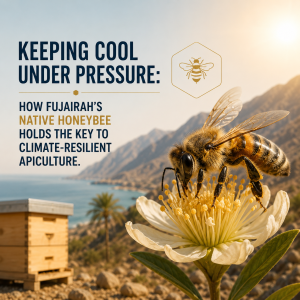
Keeping Cool Under Pressure: How Fujairah’s Native Honeybee Holds the Key to Climate-Resilient Apiculture.
As global temperatures continue to climb, agricultural systems worldwide face an unprecedented identity crisis, and in the arid and semi-arid landscapes of the United Arab Emirates, where summer temperatures regularly exceed 45°C, this crisis is not a future projection but a daily reality. While much of the global conversation around climate change centres on crop yields and water scarcity, a quieter, equally critical battle is being fought at the behavioural and physiological levels within ecosystems, and at the heart of this battle is the humble honeybee. Honeybees are the backbone of regional biodiversity and food security, contributing significantly to the UAE's annual production of honey, but commercial apiculture in the region has historically relied on imported, exotic subspecies like the European honeybee which suffer catastrophic colony losses during their very first Arabian summer because they lack the evolutionary tools to cope with extreme desert heat and fluctuating coastal humidity. When a honeybee colony gets too hot, its entire social structure shifts from productivity to survival as foraging stops, metabolic functions degrade, and workers are forced to reallocate their energy toward intensive climate control inside the hive by fanning their wings to circulate air and collecting water for evaporative cooling. This is where the Arabian Peninsula’s indigenous honeybee, Apis mellifera jemenitica, comes into focus because it is uniquely adapted to survive where other bees perish, possessing physical and cellular traits that allow it to dissipate heat rapidly and reflect intense solar radiation. At the Fujairah Research Centre, the mission is rooted in driving a sustainable economy through innovative agricultural research, and within the Honeybee Breeding & Stock Management initiative, we are currently launching a crucial comparative study to test the heat and humidity tolerance of Apis mellifera jemenitica against imported bee subspecies. While the general thermotolerance of the native bee is acknowledged, the specific, quantifiable boundaries of its heat and humidity thresholds remain an active frontier of research, which is why this project bridges this gap through empirical testing inside specialized environmental chambers. Using these precision units, we subject different bee strains to incremental changes in temperature and relative humidity to pinpoint exactly where metabolic stress begins, how humidity alters evaporative cooling efficiency, and where the physiological breaking points lie. This research is highly unique because we do not view temperature in isolation; in Fujairah’s unique geographical terrain, where rugged mountains meet the sea, high heat is frequently compounded by intense coastal humidity which limits a bee’s ability to cool itself effectively, and by running these multi-variable stress tests, the lab is mapping a highly accurate thermal safety margin for regional apiculture. The data gathered during this project does not just live in a spreadsheet but serves a direct, practical purpose to support the UAE’s National Food Security Strategy by reducing the economic risks of summer colony mortality, lowering the financial burden on local beekeepers who rely on expensive annual imports, and securing pollination services for native flora like Sidr and Ghaf trees. Working on this project has shown how academic theory transforms into impactful, real-world solutions because science at FRC is an active response to regional challenges, and by unlocking the physiological secrets of Apis mellifera jemenitica, we are proving that the answers to tomorrow's climate challenges are often already written in the DNA of native species. As we finalize the comparative data, FRC moves one step closer to building an apiculture sector that doesn't just survive the desert summer but thrives in it, ensuring that this irreplaceable regional resource is preserved for generations to come.